Efthymios Warlamis, Own work, 2007-01-05
ARCADIA

Thenot Under a Fruit Tree, from Thornton's "Pastorals of Virgil", Wood engraving by William Blake (1757–1827)
Collection of the MET, in New-York.
The idea of the perfect landscape started with poets such as Theocritus, Virgil, and Sannazaro. In the 1st century BC, the Roman poet Virgil took a rough, mountainous region of Greece—Arcadia—and reimagined it in his Eclogues.
Virgil transformed Arcadia, this rugged terrain into a poetic ideal, creating a place where the landscape was not just a backdrop, but a living entity that mirrored the human condition —a bucolic scenery of flowering meadows, woods and rivers. In his tenth Eclogue, he established the atmospheric connection between the land and the shepherd:
"The laurels and the tamarisks wept for him; Even the pine-crowned Maenalus wept, And the rocks of cold Lycaeus, as he lay Beneath a lonely cliff."
by Virgil, Eclogue X (c. 39 BCE).
This passage provided one of the first "visual grammar" for the Arcadian style. It introduced a landscape that was a 'mirror of human emotion,' built from lush laurels, towering pines, and dramatic cliffs.
This poetic vision laid the groundwork for painters like Claude Lorrain (1604-1682) and Nicolas Poussin who would follow Virgil’s guidance centuries later. They transformed Virgil’s words into a set of visual rules.
In the 17th century, paintings pioneered the 'Arcadian' aesthetic. They established a visual ideal that served as the primary model for artists for two centuries—a vision so powerful that it eventually transformed not just the canvas, but the land itself.
Claude Lorrain saw Arcadia as an expansive and serene terrain. He developed a visual language that came to define the ideal landscape. His paintings often featured specific characteristics that later artists tried to emulate:
Golden Light: This warm, hazy glow became a signature of the style, softening the distance and unifying the scene.
Frame: The viewer is rarely left in an open void; the composition is often framed by trees acting like stage curtains to direct the eye inward.
Classical Ideal: The wilderness is usually domesticated by a touch of civilisation— It usually includes a building or a figure to show a world where people and nature live together in balance.
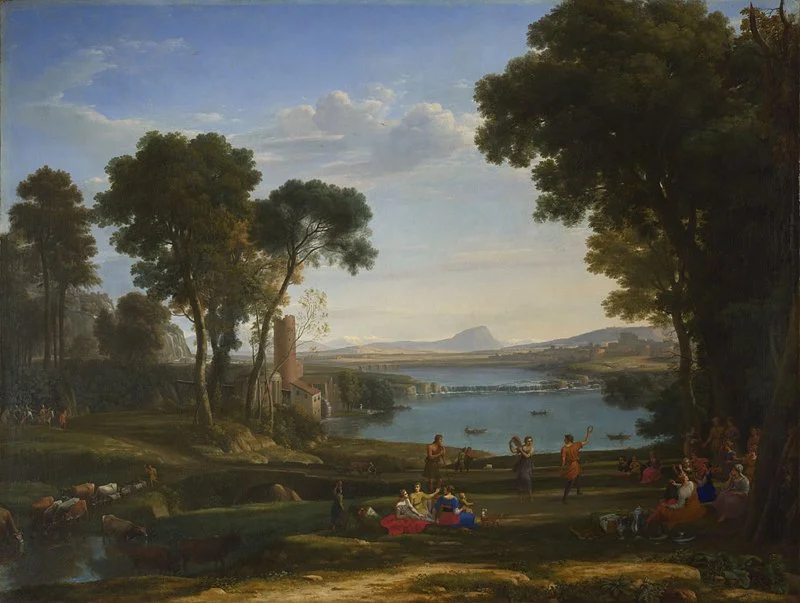
“Landscape with the Marriage of Isaac and Rebekah ('The Mill')”, Oil on canvas by Clause Lorrain (1648).
Collection of the National Gallery, in London.
The movement from canvas to gardens was accelerated by history. For generations, the British aristocracy did the “Grand Tour” - a cultural pilgrimage to Italy to view the landscapes that inspired Claude Lorrain. However, during the Napoleonic Wars in the early 19th century, travel to Europe became dangerous.
This isolation created a wish to bring these unreachable places into their own reachable backyards.
This isolation created a wish to bring these unreachable places into their own backyards. With the path to the Mediterranean blocked, British artists also lost access to the scenery that had fueled Claude Lorrain. The golden Italian landscape that defined the ideal was suddenly out of reach. Being cut off from the source of their inspiration, artists and landowners were forced to project the Arcadian dream onto their own native countryside.

“The Course of Empire: The Arcadian or Pastoral State”, Oil on canvas by Thomas Cole (ca. 1834).
Collection of the New-York Historical, in New York.
The Constructed Reality: The British Garden
In the 18th and 19th centuries, we see Arcadia moving to the garden. Rejecting the straight lines of earlier styles, the garden translated the expansive and serene terrain found in paintings. Other elements were brought from the canvas, like elegant Palladian mansions, Greek temples and ornamental cottages placed strategically to anchor the view.
An example of these interpretation can be seen for example at the Stowe House, in Stowe or Stourhead in Wiltshire. Instead of rigid grids, the garden was designed with meandering garden paths. Forcing the movement through the landscape to be slow and purposeful, revealing views established one by one, creating Arcadian visions that bore a striking resemblance to the paintings.

“ In a Shoreham Garden”, Watercolour by Samuel Palmer (ca. 1830).
Collection of the Victoria and Albert Museum, in London.
Sources:
“Dark, Imaginative Arcadias: The Merging of Landscape and Human Experience in William Blake's and Samuel Palmer's Illustrations to the Eclogues of Virgil” by Bowdoin Journal of Art and Katharine Schultz
"The Genius of the Place: The English Landscape Garden, 1620-1820" by John Dixon Hunt and Peter Willis
“British Painting: The Golden Age: From Hogarth to Turner (World of Art)” by William Vaughan